banner
Bulletin Editor
John Bauman
Speakers
May 25, 2026
Memorial Day Observed
Jun 01, 2026
Club Service- Birthday Table -Committee Mtgs Etc.
Jun 08, 2026
Falconer High School students
Jun 15, 2026
Dena Hirlemen
Jun 22, 2026
West Main Mercantile
Jun 29, 2026
Presidents Dinner
View entire list
 
 
Make Up Opportunities 
 
AM CLUB Meets at 7:30 am on the 2nd and 4th Wednesday of each month on Zoom or in person at Northwest Arena.
 
FALCONER — Meets on the 1st and 3rd Thursday of each month at 7 AM at the Falconer Fire Department Exempt Hall located at 1 Coleson Drive Falconer NY, 14733.
 
WESTFIELD / MAYVILLE — Currently meeting 2nd and 4th Tuesday at 5 pm at the Westfield YWCA - 58 S. Portage St.
 
FREDONIA/DUNKIRK
Meet Thursdays at noon at SUNY Fredonia University Village Conference Room, 2nd floor.
 
Committee meetings or social events can also be used as make-ups.
 
 
Rotarily Yours - May 11, 2026
 
President Michelle Jones led the Club in the Pledge of Allegiance. President Elect Caitlin O’Reilly led the singing of the National Anthem.

Greg Jones delivered the invocation.

Caitlin introduced her guest Dee Neslson (along with husband Tom hosted formerly visiting exchange Heath), and students Jan Steinmann (inbound) and Sophia Cama (outbound).

Michelle had some announcements:

There is a need for one more reader for the One District, One Book at 9:00 on Friday the 15th. See Becky Robbins if you are available.

Route 86 cleanup was postponed to Saturday, June 6 at 8:30 AM meet at the park and ride.

Ruth Lundin had an announcement about Hands on Jamestown which is this Saturday. We will be covering the North Main St. which we did last year. The area will be our Welcome sign until Love School. Hoping to get volunteers from JHS and will reach out to John Felton to see if any SCFCU employees are available to volunteer. She will send out an email for people to sign up to participate. Start time is 9 or 9:30. Doesn’t think this will take too long. She mentioned that the book for Read for Chautauqua is Latino Land. The author will be appearing this summer at the Chautauqua Institution (July 17). The book club will start next Monday and meet every other Monday after our Rotary meeting.  

Sophia the inbound and outbound exchange students were given a challenge to raise money for future exchange students. This will enable to go on the weekend trips that the current class now enjoys. They are going to do a couple of fundraising events in the next couple of months. These funds were usually raised at the district conference which is not occurring this year.

The bonfire at Camp Onyahsa is set for June 10. The golf tournament s Monday July 13. And June 29 is the presidential dinner.

Board of Directors meeting is Friday May 22, at 8:00 AM, at The Resource Center.

Matt Clark did the 50/50 drawing for $27.

Sergent-at-Arms Doug Conroe. Becky Robbins was mentioned twice for BPU receiving the American Public Power Association Safety Award again, and Cents for St. Susan charity kickoff. Becky thanked some of the larger sponsors and indicated the  kickoff was last Wednesday. Dan Heitzenrater indicated the Chamber of Commerce they visited 650 small businesses across Chautauqua County. Becky also received the inaugural Community Partner Award from St Susan’s.   

Happy Bucks

Michelle had a happy buck for Becky as well since Sue Jones started that charity.  

Ken Omeruo had two bucks for the recycle CHQ that he started has a partnership with library to educate people on reusing materials. The second one is he will be a panelist at the Chautauqua Institution on July 20th. To discuss reusing and the effort to reduce waste.

Jan had two things one for going to NYC with 5 other inbound exchange students. He really enjoyed the Empire State building. Second, he moved in with his new host family of Keith and Kelly Martin.

Stories
Carol Markham - Everwild Land Trust

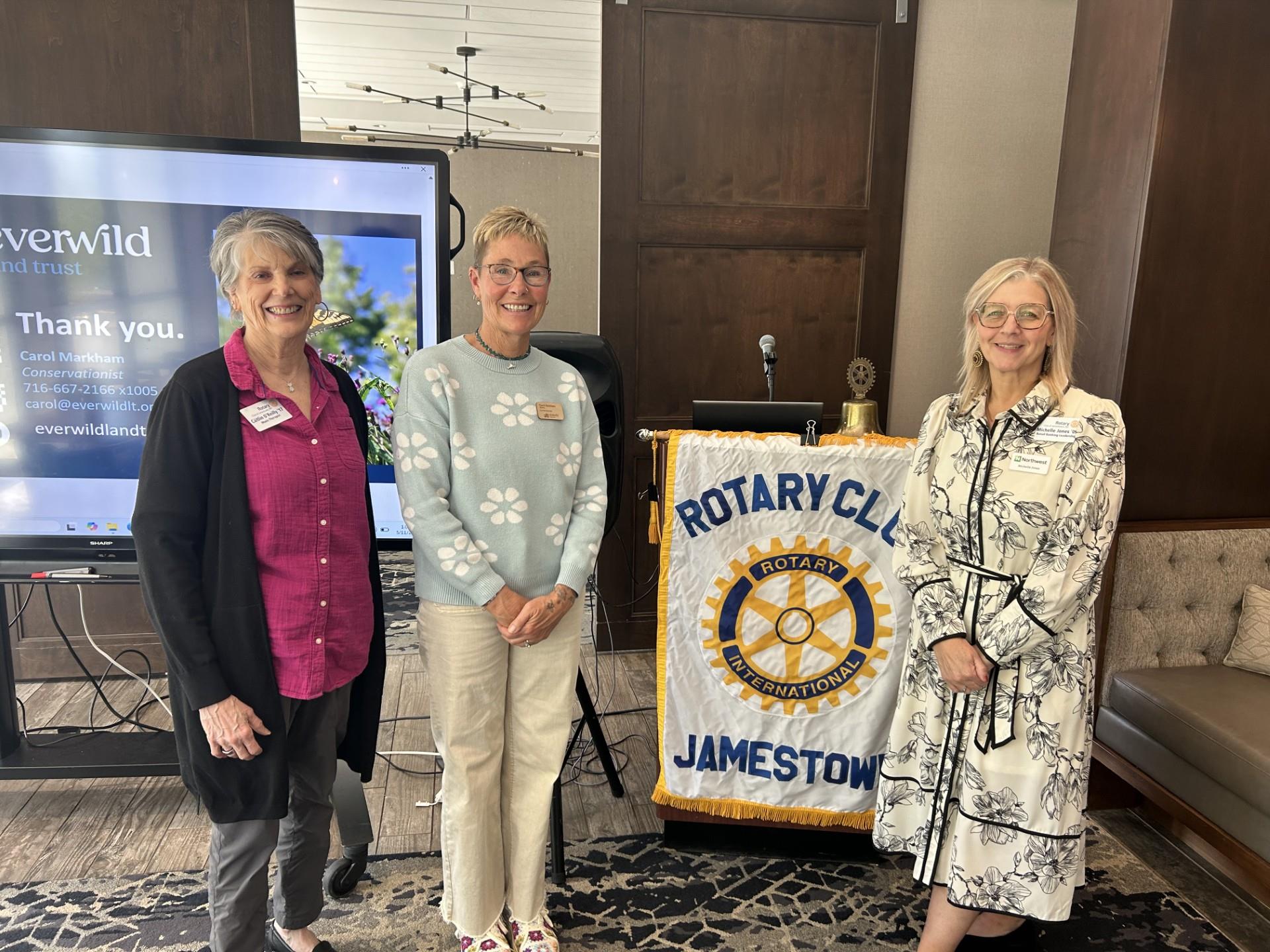
Caitlin introduced our speaker Carol Markham from Everwild Land Trust (formerly known as Chautauqua Watershed Conservancy). Her topic is Yard Smarts: From Lawn to Living Landscape. Carol Markham is the Conservationist at Everwild Land Trust. She holds a B.S. in Marine Biology from Roger Williams University and an M.S. in Fisheries Management from Ohio State University. She spent nine years as a Natural Resources Biologist for the State of Maryland, specializing in fish stock assessment in Chesapeake Bay, where she also developed a strong interest in botany.

In 1999, she joined the U.S. Fish and Wildlife Service to help lead the BayScapes Program, promoting environmentally beneficial landscaping and the use of native plants through community outreach and partnerships. After relocating to Western New York, she worked for over a decade at Turnbull Nursery in North Collins as a Nursey Associate, focusing on garden center operations, design, and native plant promotion.

In her current role, she leads the Yard Smarts program, providing personalized yard consultations that help homeowners make small, practical changes to support pollinators and wildlife while improving the health of local lakes and communities.

Carol’s presentation discussed their renaming of the trust. Their mission remains the same “Thriving Together Naturally”. The decision to rebrand was a huge endeavor to make this decision. It was announced last Wednesday and its very exciting and presents lots of opportunities.

They have grown over more than three decades bringing people together to care for the watersheds, lands, waterways and lakes that define this region. It is a renewed expression of who we are, trusted stewards rooted in community, and committed to a lasting impact. This includes their three pillars: conservation, restoration and education. Her appearance today is in relation to that third pillar.  

Even though you may have only a small property you are still part of the larger environment. If we can concentrate on some of the small things in our backyard there are a number of things we can do. Enhancing and promoting really healthy habits and habitats within that area. Smarter yards equal cleaner water and we all want cleaner water. We are blessed with much water that many areas of the US do not have. We must reduce pollutants, mange stormwater runoff, and planting native plants while removing invasives whenever possible.

Reducing pollutants include using less chemicals, fertilizers and insecticides. If you do need to use them please be judicious in their application. Use mulch or clippings to provide natural fertilization. Cleaning up dog waster is also very important. If you have a  septic tank, please make sure it maintained on a regular basis. Cleaning up leaks from your motor vehicles or other landscaping tools. In the winter modify the use of salt to melt ice.

Minimizing water runoff from your house, yard and gardens. Trying to trap and slow runoff from rainstorms. There are absorbent surfaces such as permeable driveways, decks, sidewalks, etc. Route water from gutters into your garden. Rain barrels are another option. Also rain gardens are another option in areas that are low lying. Shrink your lawn to lower the amount of mowing and plant with native plants. Clean clutter from your water gutters on the house and on the street. These all add more nutrients into our lakes.

Planting native plants, bushes and trees in your garden while eliminating invasive species. Native species provide food and shelter for our wildlife. Naturalized plants are not originally from our region but were brought over and adapted here. They may not provide food for some of our wildlife and spread rapidly due to lack of predators. Invasive plants are widely spread throughout our gardens, fields and by roadways.

Native plants are good because they can be often plant and forget unlike other plants. They have adapted to our weather and wildlife. Carol reviewed various types of native, naturalized and invasive species. 

Carol also shared some information sheets as well.  You can download them here:  Local Native Plant NurseriesDeer Resistant Native Plants.

Questions

There was a question on the loss of milkweed and its impact on the Monarch butterfly. It is basically due to loss of habitat. Land is being farmed or developed. There are b3 types of milkweed native to our area and they can be purchased and planted.

Where do you find native plants? Carol has a list of nurseries that sell native species and she will send that to us, along with plants that are more resistant to deer but not totally immune to them..

There is an event on June 14th at the 5 and 20 Distillery. Which is to support the Everwild Land Trust.

Read more...