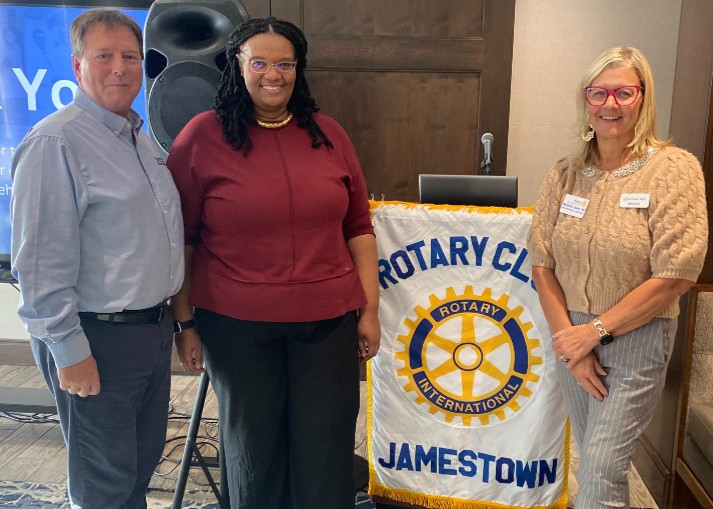
John Felton introduced the day's speaker, Patricia Graves, who shared details about the Chadakoin Valley Project. Patricia currently works at Project Management Institute, in their Global Talent Department, where she focuses on Board and HR data analytics. Driven by personal commitment to supporting community growth and positive change, Patricia dedicates much of her time to volunteer service. She is passionate about empowering communities, advocating for equitable opportunities, and helping to create environments where all individuals can thrive. Patricia serves on several local boards and committees, including the YWCA Jamestown and the Jamestown Renaissance Corporation. In her free time, Patricia enjoys traveling and reading.
Patricia explained that the Chadakoin Valley Project is an effort to research and record the history of the African American community in Jamestown, with assistance from the Fenton History Center. She explained that African Americans have lived in Jamestown since its earliest days when it was just a village. However, there is not a lot of recorded history or stories about the community. In the early days, the African America community in Jamestown was referred to as "Africa" or "Little Africa" and Patricia noted that this was initially going to be the name of the project. But she said that the Chadakoin Valley Athletic Club was very prominent in the community during the 1960s and 1970s. It was founded by Ray Hodnett and Wayne Leeper, two members of the Jamestown African American community. As a result, the title of the project borrowed from that club's name. Incidentally, the Chadakoin Valley Athletic Club eventually became Chautauqua Striders.
Patricia said the project's goal is to tell the full history of the African American community in Jamestown, building off of work that has previously been done by other community members, including Vivian and Lula Taylor. Research includes a survey that is being conducted among African American residents, asking about their connection to the community, including where their families lived. This data is then compiled, with the help of interns and volunteers, to provide a comprehensive set of information about the community that will be used to identify African American neighborhoods within the city. It will also help to make a case for another historic district to be created within the city, which can then be used to help preserve homes and other buildings associated with the African American Community. Patricia noted that this work is especially important because when the city's other historic districts were established 30+ years ago in 1993, there were 13 buildings that would have qualified for the program, had they been located within one of the historic districts. Today, only two of those residences still stand. Patricia said an ideal area to be made into a qualifying historic district would be the northside of the city, from Sixth Street north to 23rd Street, and between Washington and Main Streets.
Patricia also noted that this work is important because it is difficult to record and preserve our local African American history because so much of it is oral and sometimes it is not always accurate. An example is the first African American Church in Jamestown, which had erroneously been attributed to being started by Catherine Harris, a well known African American woman from Jamestown who assisted with the underground railroad prior to the end of slavery in the United States. For generations, many community members believed Harris also founded the first African American Church. It was only through research from another church in the community that it was discovered she hadn't actually been a founder of the church in 1881.
As the research effort continues and more information is known, the eventual goal of the Chadakoin Valley Project is to create a website that provides an interactive map, where key locations can be located and information provided about them. This information can include notable residents who lived in these homes, as well as the buildings themselves being notable among the community. She said that anyone interested in helping with the project is welcome to do so, either through volunteering their time or even making a financial contribution.
Patricia said the project's goal is to tell the full history of the African American community in Jamestown, building off of work that has previously been done by other community members, including Vivian and Lula Taylor. Research includes a survey that is being conducted among African American residents, asking about their connection to the community, including where their families lived. This data is then compiled, with the help of interns and volunteers, to provide a comprehensive set of information about the community that will be used to identify African American neighborhoods within the city. It will also help to make a case for another historic district to be created within the city, which can then be used to help preserve homes and other buildings associated with the African American Community. Patricia noted that this work is especially important because when the city's other historic districts were established 30+ years ago in 1993, there were 13 buildings that would have qualified for the program, had they been located within one of the historic districts. Today, only two of those residences still stand. Patricia said an ideal area to be made into a qualifying historic district would be the northside of the city, from Sixth Street north to 23rd Street, and between Washington and Main Streets.
Patricia also noted that this work is important because it is difficult to record and preserve our local African American history because so much of it is oral and sometimes it is not always accurate. An example is the first African American Church in Jamestown, which had erroneously been attributed to being started by Catherine Harris, a well known African American woman from Jamestown who assisted with the underground railroad prior to the end of slavery in the United States. For generations, many community members believed Harris also founded the first African American Church. It was only through research from another church in the community that it was discovered she hadn't actually been a founder of the church in 1881.
As the research effort continues and more information is known, the eventual goal of the Chadakoin Valley Project is to create a website that provides an interactive map, where key locations can be located and information provided about them. This information can include notable residents who lived in these homes, as well as the buildings themselves being notable among the community. She said that anyone interested in helping with the project is welcome to do so, either through volunteering their time or even making a financial contribution.